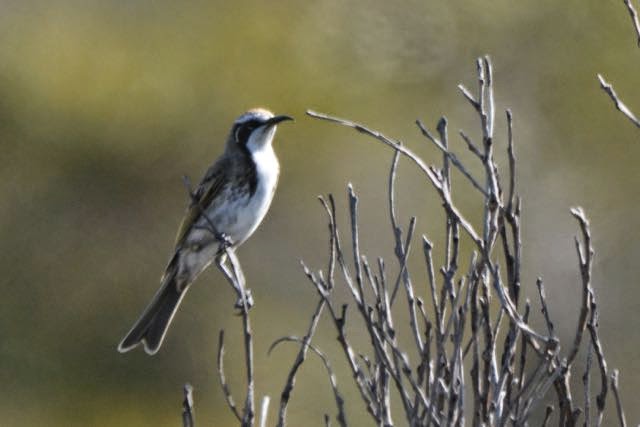
Friday, March 27, 2015

WESTERN ROSELLA

Photographed at Cheney's Beach, Western Australia March 2015
548           WESTERN ROSELLA              Platycerus icterotis

Australia        (389)

Endemic to sw. WA, s. and w. of Dongala-Israelite Bay, e. to Southern Cross-Norseman. 25-28 cm. Found in open forest, woodland with grassy clearings; trees on watercourses; farmlands, crops, roadsides, orchards.


SHORT-BILLED BLACK-COCKATOO

Photographed at Wellstead, Western Australia March 2015
547            SHORT-BILLED BLACK-COCKATOO          Calyptorhynchus latirostris

Australia           (388)

Also known as Carnaby's or White-tailed Black-cockatoo. 53-60 cm. Endemic to the sw. WA, from c. lower Murchison River to c. Israelite Bay in se., inland to L. Moore-Meriden-Norseman; breeds in n. Darling Ras. and wheatbelt then disperses coastward in summer-autumn.  Found in open forests, woodlands, scrubland, wheatbelt, and sand plain areas; taller, denser karri, exotic pine plantations, gardens.


Thursday, March 26, 2015

RED-CAPPED PARROT

Photographed very early in the morning near Ravensthorpe, Western Australia March 2015
546         RED-CAPPED PARROT          Purpureicephalus spurius

Australia      (387)

Also known as King Parrot but only in Western Australia. Found in eucalypt forests, woodlands, shelter belts, trees in farmland, timbered watercourses, roadsides, orchards, parks, gardens. Range only sw WA, s. and w. of Moore R-L. Grace-Esperance. 35-38 cm.


LAUGHING TURTLE-DOVE

Photographed at Esperance, Western Australia March 2015
545         LAUGHING TURTLE-DOVE            Streptopelia senegalensis

Australia           (386)

Also known as Senegal Dove or turtle-dove. 25-27 cm. Found in urban areas, country towns, parks, gardens, railcards, roadsides, farms and farmyards, especially in WA wheatbelt. Range from Africa to India, introduced to Perth (WA) from 1898, spread across WA wheatbelt, e. to Southern Cross, n. to beyond Geraldton, Shark Bay, s. to Albany, populations in Kalgoorlie and Esperance.


Tuesday, March 24, 2015

NULLARBOR QUAIL-THRUSH

Photographed a few kilometres from the Nullarbor Roadhouse, Nullarbor Plain, South Australia March 2015
544         NULLARBOR QUAIL-THRUSH             Cinclosoma alisteri

Australia            (385)

Until recently considered a subspecies of the Cinnamon Quail-thrush (Minclosoma cinnamomeum) this bird is rare and can only be found on the Nullarbor Plains. It inhabits low salt-bush and is mostly found around the Nullarbor Roadhouse.


Monday, March 23, 2015

SOUTHERN EMU-WREN


543         SOUTHERN EMU-WREN            Stipiturus malachurus

Australia          (384)

Also known as Button-grass Wren and Stickball. 15-19 cm, incl. tail 9-12 cm. Found in heaths with 'grasstrees', banksias, hakes, rushes, sedges, scrubby thickets, lignum, montane gullies, subalpine grasslands, heathy woodlands; in Tas. button-grass plains, montane moors; in sw. WA dune-vegetation, sand plain-heaths, dry eucalypt, acacia-spinifex. Range: coastal WA from Shark Bay south to SA border; Eyre Pen. (SA) from Adelaide coastal to Vic. border; coastal Vic., NSW to above Brisbane in Q.; all Tas.

NOTE: Up to eleven subspecies have been described with seven being recognised. 


Subspecies westernensis photographed at Cheyenne's Beach, WA, November 2016


Subspecies littleri, photographed on South Coast Track, Tasmania February 2017


CASPIAN TERN

Photographed Coffin Bay National Park, South Australia March 2015
542          CASPIAN TERN              Sterna caspia

Australia       (383)

Largest of the terns. 48-55 cm; wingspan 1.1-1.4 m. Found coastal, offshore waters; beaches, mudflats, estuaries, larger rivers, reservoirs, lakes, some inland. Range Aust, including Tasmania: seldom numerous. Not in driest parts of central Western Australia.


TAWNEY-CROWNED HONEYEATER

PhotographedLincoln National Park, South Australia March 2015
541        TAWNEY-CROWNED HONEYEATER             Phylidonyris melanops

Australia           (382)

16-17 cm. Found in heathlands; stunted banksia, sandplain vegetation; mallee, 'grass-tree country', blossoming eucalypt woodlands, regrowth, button-grass woodlands, strutters. Ranges from ne. NSW (Evans Head) to Eyre Pen. Kangaroo Is (SA), inlands to Blue Mountains (NSW); coastal e. Vic. to Big Desert NP. Coastal Tas.; In s WA widespread w. and s. of Israelite Bay-Norseman-southern Cross-Murchison R.


Photographed Coffin Bay National Park, South Australia March 2015


Saturday, March 21, 2015

WESTERN YELLOW ROBIN

Photographed at Port Lincoln National Park, March 2015 this bird is of the race (subspecies) rosinae.
540       WESTERN YELLOW ROBIN          Eopsaltria griseogularis

Australia    (381)

15-16 cm. Found in open forests, woodlands, with 2-3 m shrub layer; coastal and acacia scrubs, dense mallee; woodlands-saltbush associations; mostly avoids dense wet thickets. Range sw. WA, n. and e. to Shark Bay-Kalgoolie-Eucla; s. SA, from Nullarbor NP at head of Bight, coastally e. to Cedunna-Wynbring, Eyre Pen. and Gawler Ras. (SA).


Thursday, March 19, 2015

WHITE-FRONTED HONEYEATER

Photographed at the Arid Garden, Port Augusta, South Australia March 2015
539       WHITE-FRONTED HONEYEATER             Phylidonyris albifrons

Australia          (380)

16-18 cm. Found in drier inland and coastal scrubs, heaths; mulga, mallee, blossoming shrubs, timber on watercourses, eucalypt woodlands. Range widespread on mainland w. of Divide and s. of tropical n. Aust. Resident coastal WA; Broome-Perth and s. coast Albany (WA)-Coorong (SA); moves tp coastal s. Aust in summer; n. to Kimberley and n. coast in winter.


RED KNOT

Photographed at Thompson's Beach, South Australia March 2015
538        RED KNOT           Calidris canutus

Australia          (379)

Ranges around entire coast of Australia mainland and Tasmania; Breeds in Arctic Circle; birds from n.-c and ne. Siberia and n. Alaska migrate regularly to Australia. Found on tidal mudflats, sandblast, beaches, salt marshes, flooded pastures and ploughed land. 23-26 cm.


SANDERLING


537          SANDERLING              Calidris alba

Australia          (378)

19-21 cm. Found on broad beaches of firm sand 'where waves ebb and flow', depositing strands and heaps of seaweed; often near river mouths, also inlets, tidal mudflats, coastal lagoons. Breeds around Arctic from Spitsbergen e. to Iceland, migrates to coasts of s. continents. Regular summer visitor to Australian coasts.