Showing posts with label tern. Show all posts

Saturday, February 15, 2025

BLACK SKIMMER


1387                    BLACK SKIMMER                 Rynchops niger

USA               44

The black skimmer is a tern-like seabird, one of three similar bird species in the skimmer genus Rynchops in the gull family Laridae. It breeds in North and South America. Northern populations winter in the warmer waters of the Caribbean and the tropical and subtropical Pacific and Atlantic coasts, but South American populations make only shorter movements in response to annual floods which extend their feeding areas in the river shallows.

Skimmers have a light graceful flight, with steady beats of their long wings. They usually feed in large flocks, flying low over the water surface with the lower mandible skimming the water for (in order of importance) small fish, insects, crustaceans and molluscs caught by touch by day or especially at night.


ROYAL TERN


 1386                  ROYAL TERN                Thalasseus maximus

USA           43

The royal tern is a tern in the family Laridae. The species is endemic to the Americas, though vagrants have been identified in Europe. The royal tern usually feeds on small fish such as anchovies, weakfish, and croakers. Fish are their main source of food but they also eat insects, shrimp,crabs, and hatchling sea turtles.The royal tern feeds on small crabs, such as young blue crabs that swim near the surface of the water. When feeding on small crabs the royal tern does not use its normal plunge-dive technique, but instead uses short shallow dives so that they are concealed from their prey. The royal tern also uses this technique when hunting flying fish.


SANDWICH TERN


 1385                      SANDWICH TERN                        Thalasseus sandvicensis

USA                  42

The Sandwich tern is a tern in the family Laridae. It is very closely related to the lesser crested tern (T. bengalensis), Chinese crested tern (T. bernsteini), Cabot's tern (T. acuflavidus), and elegant tern (T. elegans) and has been known to interbreed with both elegant and lesser crested. It breeds in the Palearctic from Europe to the Caspian Sea and winters in South Africa, India, and Sri Lanka.

Like all Thalasseus terns, the Sandwich tern feeds by plunge-diving for fish, almost invariably from the sea. It usually dives directly, and not from the "stepped-hover" favoured by Arctic terns. The offering of fish by the male to the female is part of the courtship display.


Sunday, November 26, 2023

WHISKERED TERN


Photographed at Kampong Phluk Floating Village, Siem Reap, Cambodia, November 2023

(* 409)       WHISKERED TERN           Chlidonias hybrida

CAMBODIA                  37

Largest marsh tern, 25-27 cm, wingspan 70 cm. Found in vegetated and open wetland; brackish, saline lakes; saltfields, irrigated land, sewerage ponds. C. h. hybrida breeds in warmer parts of Europe and the Palearctic (northwestern Africa and central and southern Europe to southeastern Siberia, eastern China and south to Pakistan and northern India). The smaller-billed and darker C. h. delalandii is found in east and south Africa, and the paler C. h. javanicus from Java to Australia.


Monday, March 18, 2019

ROSEATE TERN

Photographed on West Island, Lacepedes, WA, March, 2019

1269                   ROSEATE TERN                   Sterna dougallii     

AUSTRALIA                769

In Australia restricted to tropical and subtropical seas and coastlines from Perth to Brisbane. Feeds at sea, usually over deeper water; not often seen from mainland; mainly associated with coral reefs and sparsely vegetated islands above high-water mark. Two subspecies: bangsii and gracilis.


(bird at rear)


Tuesday, December 12, 2017

ALEUTIAN TERN

Photographed at Old Bar, NSW, December 2017
1230                 ALEUTIAN TERN               Onychoprion aleuticus 

AUSTRALIA                  723

Former Latin name was Sterna aleutica. Breeds in colonies on coasts and islands in Alaska and easternmost Siberia; migrates to Indonesia and Malaysia, though little is known about its wintering habits here. Feeds by plunge diving for fish, usually in saltwater environs.

NOTE:  In October 2017, birders Liam Murphy was looking through photographs taken in December 2016. He found an unidentified tern. It was tentatively identified as an Aleutian tern, never before recorded in Australia. He returned to the place where the photographs were taken in December 2017. Liam found a group of 13 Aleutian tern wintering there. (These photographs were taken the next day)


Saturday, July 1, 2017

BLACK-FRONTED TERN

Photographed at Hawkes Bay, New Zealand, June 2017
1211                 BLACK-FRONTED TERN               Chlidonias albostriatus 

NEW ZEALAND                 75

Endemic. About 8000 birds breed in small colonies on gravel riverbeds of South Island, mainly east of Southern Alps; migrates to coast to feed at sea, especially in Cook Strait and off eastern coast of both Islands, as far north as Bay of Plenty.


Friday, June 30, 2017

WHITE-FRONTED TERN

Photographed at Miranda, June 2017
1200                 WHITE-FRONTED TERN               Sterna striata  

NEW ZEALAND               49

Favours coastal waters and harbours, roosts on sandbanks or sandpits, rarely inland. 42 cm. A small number breed in Bass Strait, Australia, the rest, 15,000-20,000 pairs are New Zealands most abundant tern found all around the coast and on off-shore islands.


CASPIAN TERN

Photographed at Miranda, June 2017
(*   542)               CASPIAN TERN               Hydroprogne caspia

NEW ZEALAND            48

An uncommon native in New Zealand; about 4,00 birds in NZ, breeding widely; colonies found on sandpits, and shellbacks of coast and harbours, some parts of riverbeds and lake shores. Feeds in off-shore waters.


Monday, May 1, 2017

WHITE-WINGED TERN

Photographed in Sri Lanka, March 2017

(*   504)                 WHITE-WINGED TERN                 Chlidonias leucopterus    

SRI LANKA           56
Found over marshes, lakes, paddy fields, tanks, lagoons and salt-pans. 20-23 cm. Fairly common winter migrant mainly to dry lowlands, fairly rare inset lowlands. Also referred to as White-winged Black Tern.


Saturday, April 15, 2017

GULL-BILLED TERN

Subspecies nilotica, photographed March 2017
(*  737)                 GULL-BILLED TERN                  Gelochelidon nilotica   

SRI LANKA             28

Found on coast, lagoons, salt-pans, sand spits, tidal flats and tanks. 35-38 cm. Fairly common winter migrants mainly to dry coastal areas, uncommon in wet coastal areas, and rare on inland wetlands; possibly few pairs breed on offshore islands of northern coast.


Tuesday, December 20, 2016

SAUNDERS'S TERN


944                    SAUNDERS'S TERN             Sternula saundersi

AUSTRALIA (Cocos Islands)           673

Not very well known tern, also called Black-shafted Tern, and often mistaken for Little Tern. Inhabits coastal areas, and up to two kilometres inland, ranging up to 15 kilometres out to sea when feeding. Found in Bahrain, Iran, Israel, Kenya, Madagascar, Pakistan, Oman, Saudi Arabia, Sri Lanka, Tanzania, United Arab Emirates, and Yemen. Small flock appears on South Island in the Cocos Islands, this may be just a few birds or up to 20.


Photographed Cocos Islands, January 2023


Sunday, October 23, 2016

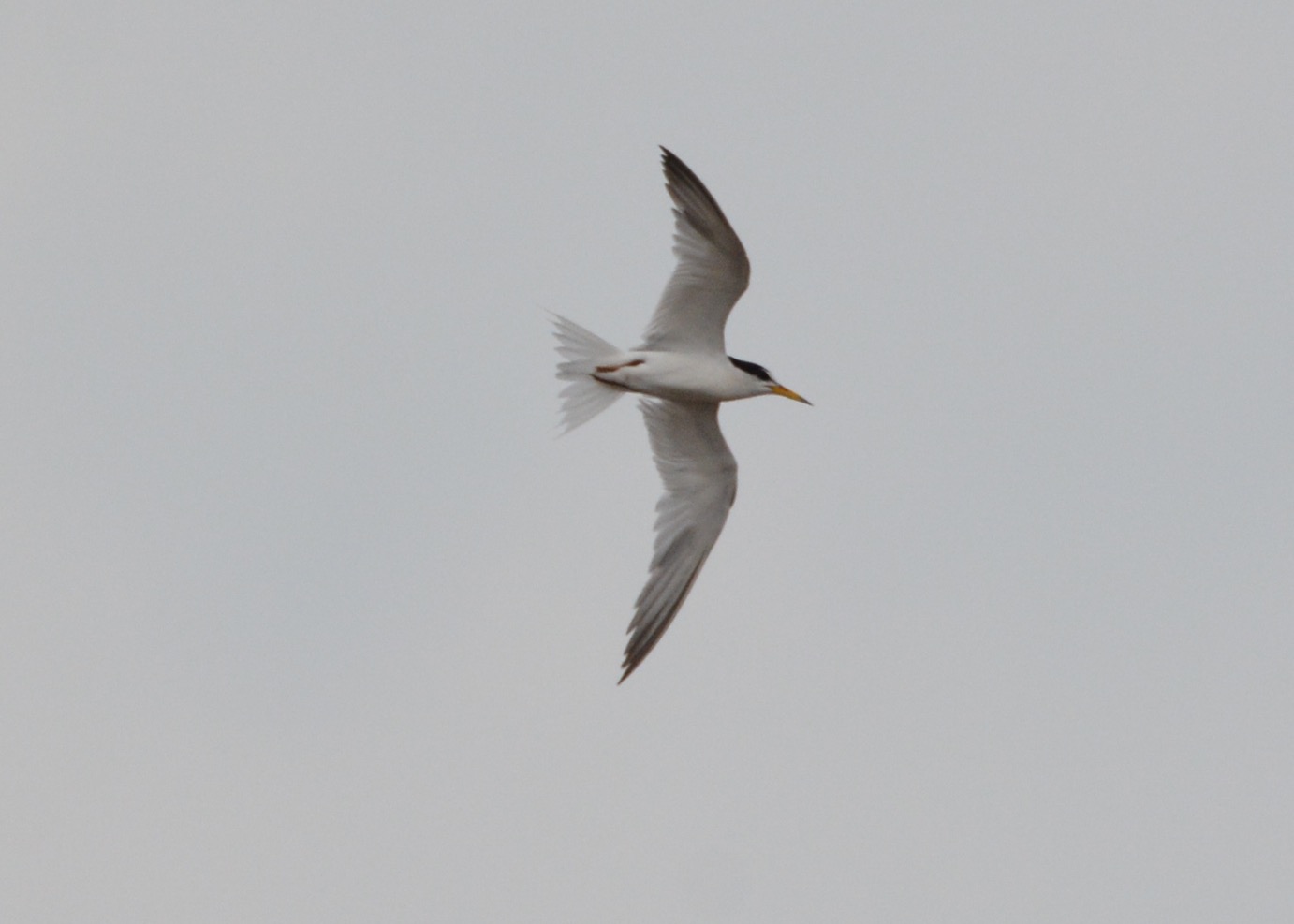
LITTLE TERN

Photographed in north-west Bali October 2016 
(see   287)              LITTLE TERN               Sterna albifrons 

INDONESIA (Bali)         (73)        

Usually seen in coastal regions and sometimes around freshwater lakes and rivers as much as 100 kms inland. 23 cms. Distribution: Breeds in Africa, Eurasia and Australia; partly migratory; widespread and fairly common winter visitor throughout Indonesia; also resident on Java, Bali and Wallacea.